
MOF-mediated cascade photoreactions under nanoconfinement for defluorination of per- and polyfluoroalkyl substances
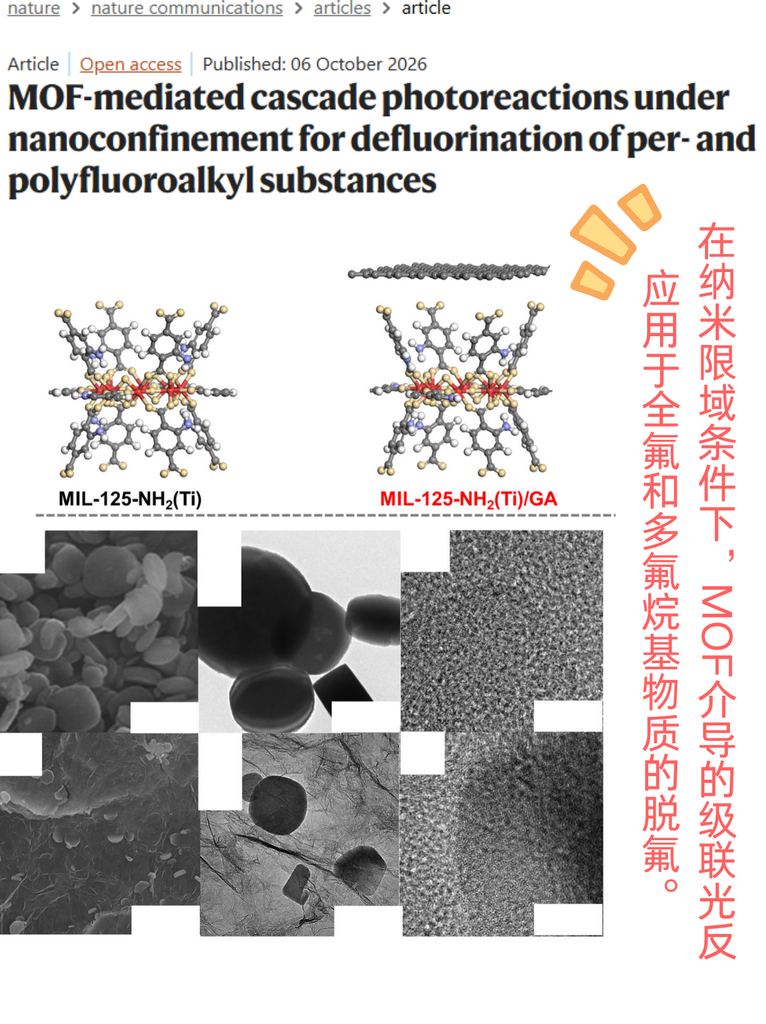
Background
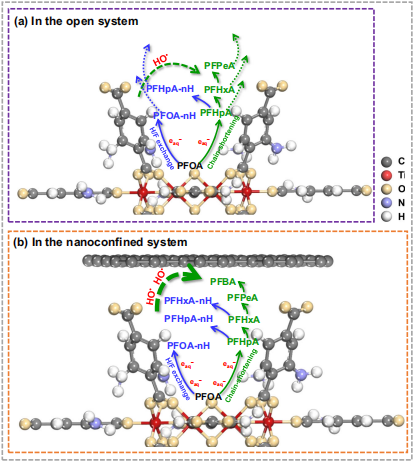
PFAS resist degradation due to strong C–F bonds and bioaccumulate. Conventional oxidation or reduction often only shortens the chain, leaving more stable, hydrophilic intermediates that limit defluorination. Heterogeneous systems trying to combine reduction and oxidation suffer from self-quenching, and short-chain PFAS struggle to reach catalytic sites. The target is to enrich PFOA and its PFCA/FTCA intermediates at the interface, enabling sequential reduction–oxidation.
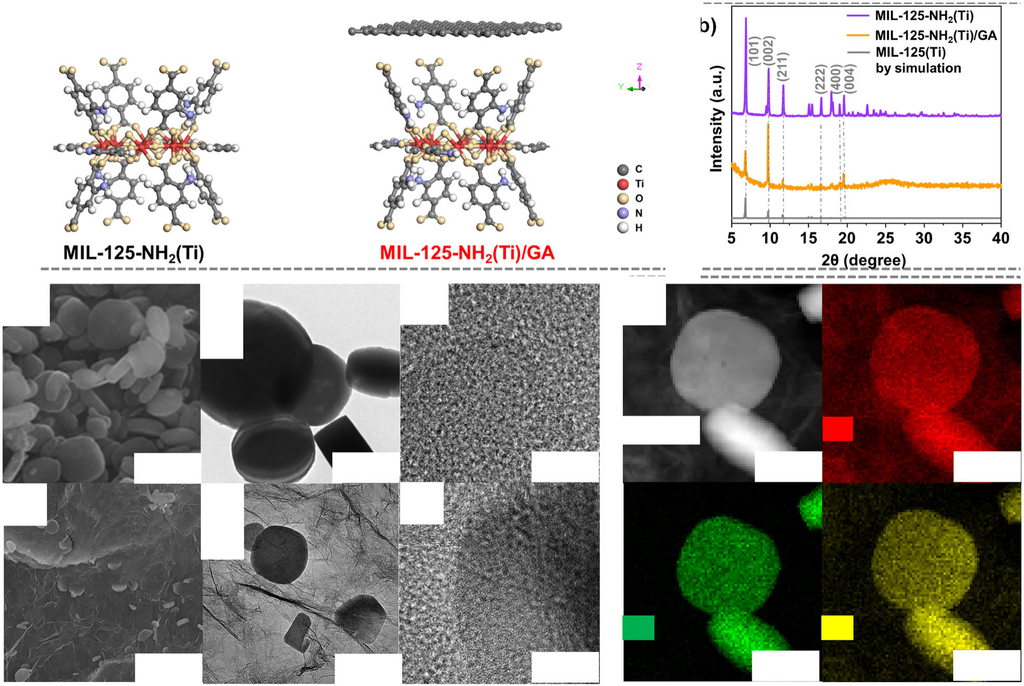
Innovation–MOF
MIL-125-NH2(Ti) encapsulated in graphene aerogel generates both hydrated electrons and hydroxyl radicals under UV, achieving cascade reduction–oxidation in one system. Nanoconfinement boosts PFAS adsorption affinity by over 30%, lowers C–F bond energy by up to 10.8%, and mitigates self-quenching. In 12 h, defluorination reaches 90.2% for PFOA, 65.3% for PFHxA, and 51.8% for PFBA. The targeted design confines short-chain intermediates, enabling continued C–F cleavage.
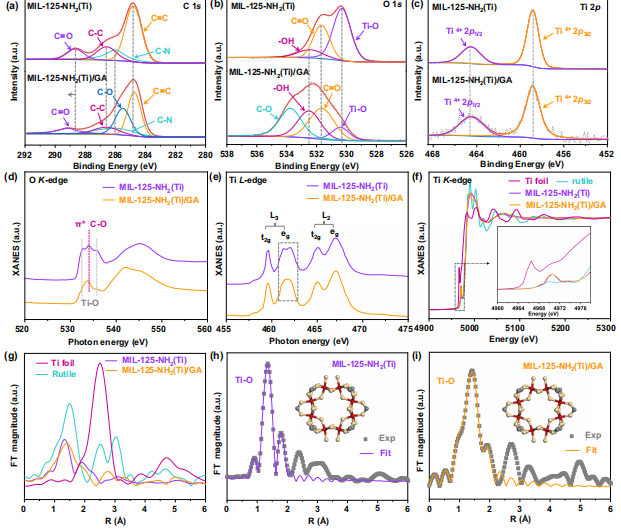
Material Study–MOF
MIL-125-NH2(Ti) is a Ti-based MOF providing photogenerated electrons and open Ti sites. The graphene aerogel builds a 3D confined framework, restricts MOF growth, enhances light absorption and charge transfer, and reduces Ti leaching. XPS and XAS confirm Ti remains tetravalent with slightly reduced coordination, favoring interfacial charge transfer and PFAS adsorption. The material targets confinement-enriched pollutants and electron/radical synergy for deeper defluorination.
Note: This is only a frontier research update and does not constitute any related advice.
#PFAS #Photocatalysis #MOF #Nanoconfinement #GrapheneAerogel #Defluorination #EnvironmentalRemediation #ResearchFrontier