
Immune Nanoenhancer: A New Framework for Reprogramming Chemotherapy and Activating Tumor-Derived dsDNA Immunity
Immune nanoenhancer technology is emerging as one of the most promising advances in the field of nanomedicine, offering a strategy to reprogram conventional chemotherapeutic agents into powerful immunomodulators. Traditional chemotherapy is designed primarily for cytotoxicity, yet this approach alone rarely produces durable clinical responses. Modern oncology increasingly recognizes that an effective cancer treatment must not only kill tumor cells but also activate multiple stages of the cancer-immunity cycle.
One of the most critical yet underutilized immune pathways is the cGAS–STING axis, responsible for sensing tumor-derived double-stranded DNA (dsDNA) and igniting strong innate and adaptive immune responses. Activating this pathway safely and sustainably has long been a challenge. Approved STING agonists often exhibit poor tumor retention, systemic toxicity, or limited clinical efficacy. Similarly, chemotherapy cannot achieve sufficient tumor-localized dsDNA generation without harmful doses.
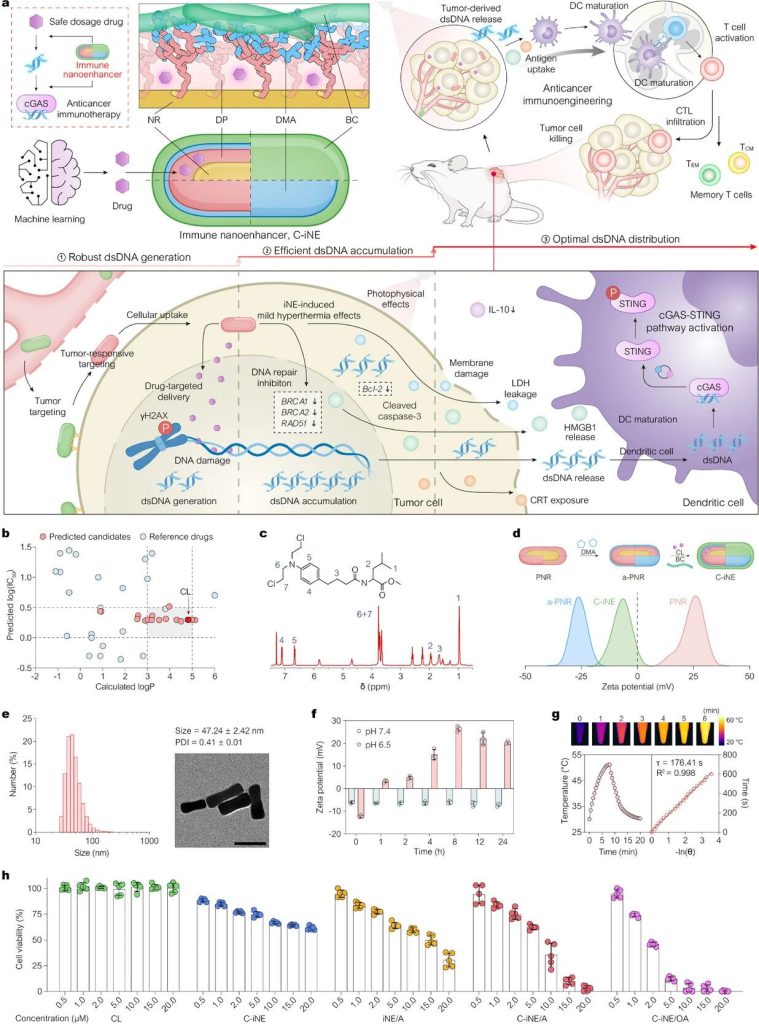
A recent breakthrough study published in Advanced Materials introduces a rationally engineered immune nanoenhancer platform (C-iNE/A) that solves this problem. By integrating machine-learning-guided drug encapsulation, tumor-targeted nanoscale delivery, and photophysically triggered mild hyperthermia, this system reprograms existing chemotherapeutics into low-dose inducers of dsDNA accumulation—thereby activating the cGAS–STING pathway from within the tumor microenvironment.
1.Reprogramming Chemotherapy into a Tumor-Localized dsDNA Generator
Traditional chemotherapy generates DNA damage indiscriminately, affecting both tumor and healthy tissue. The immune nanoenhancer addresses this limitation by redesigning chemotherapeutics to function as precision intracellular dsDNA stimulators, rather than blunt cytotoxic tools.
Machine learning identifies the optimal encapsulation ratio, enabling the drug-loaded nanoparticles to accumulate preferentially inside tumors. Once internalized, controlled drug release produces a burst of DNA fragments that serve as intrinsic immunogenic danger signals.
This is a paradigm shift:
Chemotherapy becomes immunogenic, not merely cytotoxic.
3.Completing the Full Cascade of Immune Activation
The immune nanoenhancer bridges multiple gaps in the cancer-immunity cycle:
- Tumor DNA damage
- Tumor-localized dsDNA accumulation
- Activation of cGAS–STING innate signaling
- Dendritic cell maturation
- T-cell priming and infiltration
- Establishment of memory T-cell populations
Preclinical studies demonstrate:
- enhanced CD8⁺ cytotoxic T-cell infiltration
- increased dendritic cell activation
- suppression of tumor metastasis
- durable memory responses preventing recurrence
Even at low doses, the platform showed superior antitumor immunity compared with traditional chemotherapy or STING agonists.
4.Expanding the Strategy to Other Immune-Sensing Pathways
The principles demonstrated by the immune nanoenhancer can extend to several additional innate immune pathways. For example:
- Mitochondrial DNA leakage could activate TLR9
- Cytosolic RNA fragments might stimulate RIG-I or MDA5
- Oxidized nucleic acids could trigger NLRP3 inflammasome signals
These extensions suggest a future where nano-enabled “immune programming” becomes a central therapeutic concept across many cancer types, including those resistant to DNA-damage-based interventions.
5. Integrating Real-Time Imaging and Adaptive Therapy
Future versions of immune nanoenhancers may incorporate:
- real-time biosensors to monitor tumor microenvironment changes
- smart temperature control systems that adjust photothermal stimulation
- feedback-driven drug release based on intracellular stress signals
This would create a dynamic treatment system capable of adapting to each patient’s tumor behavior in real time—a hallmark of next-generation precision oncology.
6. Transforming Existing Clinical Modalities Through Nanotechnology
One of the most important conceptual contributions of this research is the idea that traditional treatments can be “immune-empowered.” For example:
- radiotherapy could be engineered to release more dsDNA
- cryotherapy might be paired with nanoparticles to increase immunogenic cell death
- ultrasound ablation may be combined with nanocarriers to release tumor antigens
Rather than replacing existing treatments, immune nanoenhancers upgrade them with systemic immunological benefits—improving long-term control and reducing recurrence.
Conclusion
The immune nanoenhancer represents a transformative step in modern cancer therapy, shifting chemotherapy from a purely cytotoxic treatment into a targeted activator of tumor-derived dsDNA and the cGAS–STING pathway. By integrating intelligent drug packaging, precise nanoscale delivery, and mild photothermal modulation, this platform achieves robust immune activation with minimal toxicity. As research expands toward adaptive, sensor-driven, and multi-pathway immune programming, immune nanoenhancers may become a foundational technology for next-generation cancer immunotherapy.
Authoritative External Resource
Official journal page of Advanced Materials (publisher of the original study):
https://onlinelibrary.wiley.com/journal/15214095
Learn more about nanomaterial-based immune modulation