
10 Powerful Insights into Carbon Nitride Nanotubes for Next-Generation Materials
Carbon nitride nanotubes have emerged as one of the most promising metal-free nanostructures in modern materials science. Their tunable nitrogen-rich framework, hollow tubular morphology, and semiconducting electronic properties make them highly attractive for energy, catalysis, sensing, and environmental technologies. As global interest in sustainable and scalable nanomaterials increases, carbon nitride nanotubes are gaining rapid recognition as a next-generation alternative to traditional carbon nanotubes and metal-based catalysts.
What Are Carbon Nitride Nanotubes?
Carbon nitride nanotubes (CNNTs) are tubular nanostructures primarily composed of polymeric graphitic carbon nitride (g-C₃N₄). Unlike carbon nanotubes, which rely exclusively on sp²-bonded carbon, CNNTs incorporate a high concentration of nitrogen atoms. This nitrogen-rich backbone enhances catalytic activity, enables tunable surface chemistry, and provides unique electronic states not seen in pure carbon frameworks.
Key characteristics include:
- A semiconducting bandgap (~2.6–2.9 eV)
- High thermal and chemical stability
- Strong visible-light absorption
- Metal-free, environmentally friendly composition
- Adjustable structure through controlled synthesis
Because of these features, carbon nitride nanotubes have become a compelling platform for photocatalysis, energy devices, and membrane engineering.
Synthesis Strategies for Carbon Nitride Nanotubes
1. Hard-Template Synthesis
This classical approach uses rigid templates—such as porous alumina, silica, or anodic aluminum oxide—to guide the formation of nanotubes. Precursors like melamine or urea infiltrate the template, followed by calcination. After thermal polymerization, the template is chemically removed, leaving uniform hollow CNNTs with controlled diameters.
2. Soft-Template and Self-Assembly Methods
Soft templating relies on surfactants, micelles, or supramolecular assemblies to direct nanotube formation. This method is inexpensive, scalable, and ideal for large-volume production. The resulting carbon nitride nanotubes often exhibit thinner walls and higher surface area, which enhance catalytic performance.
3. Thermal Conversion and Vapor-Phase Routes
Advanced methods such as chemical vapor deposition and thermal transformation allow precise control over crystallinity, nitrogen distribution, and defect sites. These techniques are particularly valuable for electronic and optoelectronic applications where structural precision is essential.
Fundamental Properties of Carbon Nitride Nanotubes
Carbon nitride nanotubes combine the advantages of semiconducting polymers with the functionality of nanostructured carbon. Their most significant properties include:
- High nitrogen content improving catalytic reaction sites
- Excellent thermal endurance suitable for harsh environments
- Strong chemical resistance in acidic and alkaline systems
- Efficient electron and hole transport due to tubular architecture
- Lightweight and mechanically stable
- Visible-light activity enabling photocatalytic applications
These characteristics make CNNTs a versatile material for diverse scientific and industrial fields.
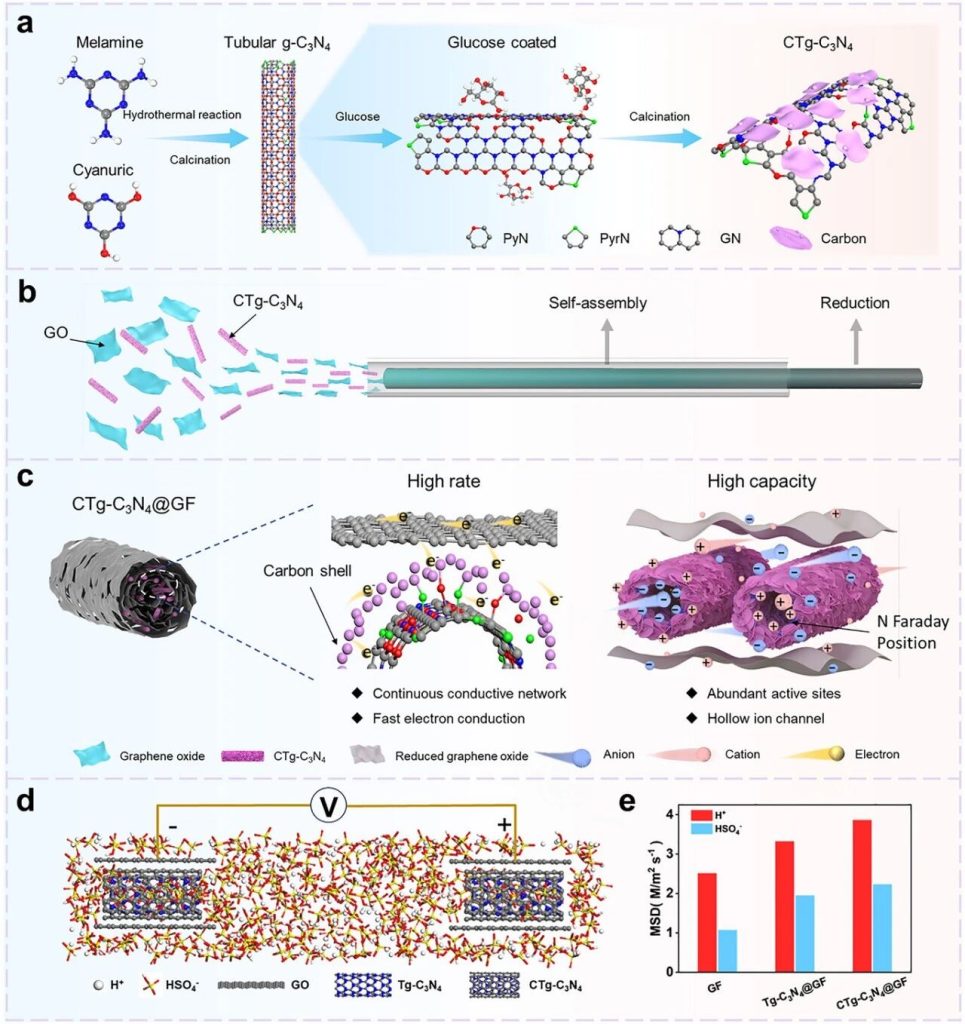
Key Applications Across Emerging Technologies
1. Photocatalytic Hydrogen Production
Among all applications, photocatalysis remains the most studied. Carbon nitride nanotubes exhibit improved charge separation, higher active-site density, and enhanced surface redox capability compared with planar g-C₃N₄. This makes CNNTs efficient photocatalysts for water splitting and hydrogen evolution under visible light.
2. Energy Storage: Batteries and Supercapacitors
The nitrogen-doped tubular structure boosts electron mobility and ion diffusion pathways. As a result, CNNTs are being incorporated into:
- Supercapacitor electrodes
- Lithium-ion battery anodes
- Metal–air battery catalysts
Their chemical stability also prevents structural degradation during long-term cycling.
3. Gas Separation and Filtration Membranes
The tunable pore structure and adjustable surface chemistry of carbon nitride nanotubes allow selective molecular transport. This positions CNNTs as promising candidates for gas purification, CO₂ capture, and molecular sieving applications.
4. Environmental Remediation
Under visible-light irradiation, CNNTs can degrade organic contaminants, dyes, pharmaceutical residues, and volatile pollutants. Their metal-free nature avoids secondary contamination, making them ideal for green chemistry and wastewater treatment.
5. Sensors and Electronic Devices
Defect sites, nitrogen heteroatoms, and semiconducting properties enable CNNTs to function in:
- Chemical sensors
- Photoelectrochemical detectors
- Optoelectronic components
Their mechanical flexibility allows integration into next-generation flexible electronics.
A comprehensive peer-reviewed overview of carbon nitride-based nanomaterials can be found in the following scientific article published by MDPI:
https://www.mdpi.com/2079-4991/11/6/1448
Explore high-quality solutions here:
https://maxnanoadvancedmaterials.com/products/
These products are suitable for laboratory setups, nanofabrication workflows, and prototype development, making them a practical complement to carbon nitride nanotube research.
Future Perspectives
Carbon nitride nanotubes are poised to play a crucial role in sustainable nanotechnology due to their combination of high performance, tunability, and environmentally benign composition. Future developments are expected to focus on:
- Increasing crystallinity for electronic applications
- Engineering heterostructures with metals and carbon frameworks
- Scaling production for industrial deployment
- Enhancing visible-light photocatalytic efficiency
- Integrating CNNTs into multifunctional composite materials
As research continues to expand, carbon nitride nanotubes may become a key material in clean energy conversion, advanced catalysis, and next-generation semiconductor devices.