
Sunlight-Triggered Bacterial Membrane-Targeting Aggregation-Induced Emission “Nanoantibiotic” Hydrogel for Ultrafast Multidrug-Resistant Bacteria Eradication and Diabetic Wound Healing
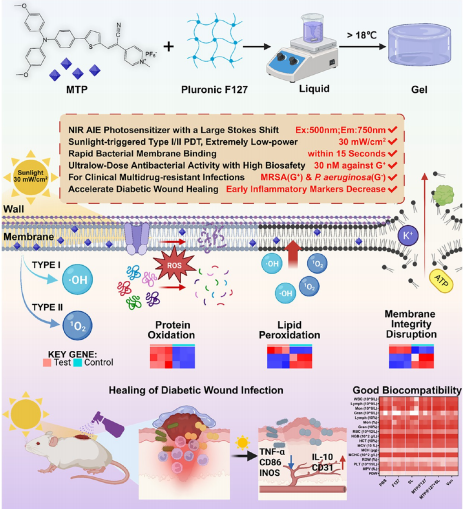
Background:
Diabetic wounds often carry drug-resistant bacteria and mature biofilms, which drive repeated local infection and slow repair. Antibiotics usually act on specific targets, so resistance can emerge, and the biofilm barrier blocks penetration. Photodynamic action uses ROS to attack multiple sites and is less prone to resistance, but many photosensitizers suffer from aggregation-caused quenching and need lasers. The key question is how to bring a photosensitizer close to the bacterial membrane and make ROS under natural sunlight.
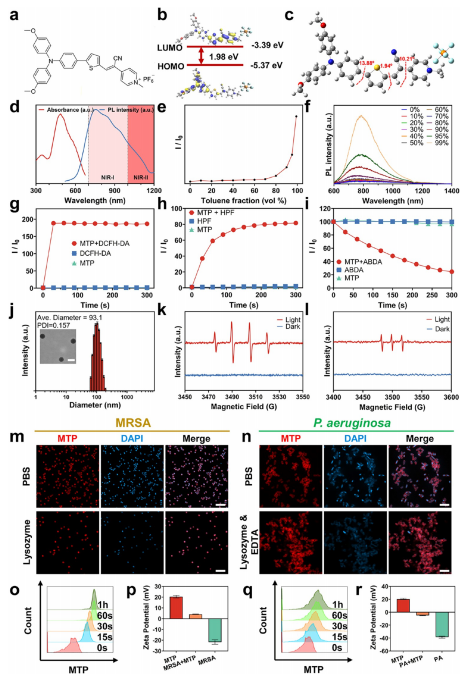
What stands out:
MTP is a D-π-A AIE photosensitizer with visible-light absorption and NIR emission. Sunlight triggers both Type I and Type II ROS. Its cationic and hydrophobic parts work together to anchor to bacterial membranes within 15 s. Ring-like fluorescence remains on wall-free protoplasts, showing membrane targeting rather than wall binding. At 30 nM, it strongly lowers Gram-positive viability and penetrates mature biofilms. The damage links to lipid peroxidation, disturbed transport, and collapsed protein homeostasis.
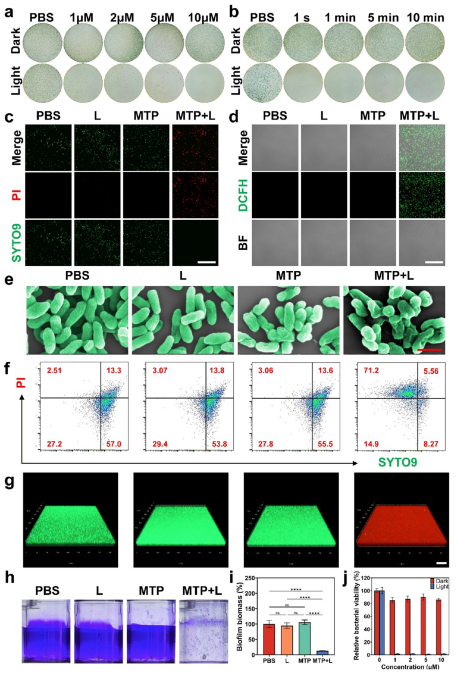
Material design:
MTP was loaded into a 20% F127 thermosensitive hydrogel. It flows at 4 °C, gels at 37 °C, and shows injectability, self-recovery, and shear thinning. SEM shows a porous network, and release follows non-Fickian diffusion, which supports local retention and sustained release. In MRSA-infected diabetic mice, the sunlight-activated group had 35.5% residual wound area on day 6 versus 87.4% in the control, close to the positive control, with lower TNF-α and higher IL-10. Major organs and blood chemistry showed no obvious abnormalities.
Note: This is only a research highlight and does not constitute any related advice.
#AIE #AggregationInducedEmission #MembraneTargeting #Photosensitizer #Hydrogel #DrugResistantBacteria #Biofilm #DiabeticWound #WoundRepair #Nanomaterials #ResearchFrontiers
DOI: 10.1021/acsnano.6c10049