Overview
Graphene oxide (GO) is an oxidized derivative of graphite, first prepared in 1859 by chemist Benjamin Brodie. This two-dimensional nanomaterial consists of single-atom layers featuring both sp² and sp³ hybridized carbon atoms, decorated with hydrophilic functional groups including hydroxyl, epoxy, and carboxyl groups. These groups grant exceptional dispersibility in water and polar solvents.
Multiple methods can produce graphene oxide, such as chemical vapor deposition, mechanical exfoliation, and solvent-based techniques. Among these, chemical oxidation routes—like the Hummers, Brodie, or Staudenmaier methods—are most suitable for large-scale production due to their cost efficiency and simplicity. With excellent film-forming ability, tunable surface chemistry, and a high specific surface area, graphene oxide is widely used in energy storage, biomedicine, environmental engineering, sensors, and polymer composites.
Specifications
-
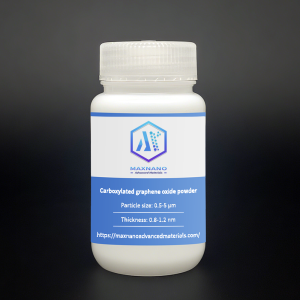
Form: Powder
-
Flake Diameter: 0.5–5 μm
-
Thickness: 0.8–1.2 nm
-
Purity: ~99% (by EDS)
-
Monolayer Ratio: >99%
Key Features
-
Single-Layer Structure: High monolayer content (~99%) with wrinkled morphology for enhanced stability and reactivity.
-
Superior Dispersion: Stable in aqueous and polar solvents due to abundant oxygen functional groups.
-
Easily Functionalized: Surface groups enable chemical modification for tailored applications.
-
Abundant Active Sites: Facilitates integration with polymers, metals, and biomaterials.
-
Adjustable Properties: Optical and electrical behavior can be tuned via reduction, doping, or functionalization.
Applications
-
Electronics: Used in field-effect transistors, chemical sensors, biosensors, and flexible circuits.
-
Energy Storage: Electrode material in lithium-ion batteries and supercapacitors for high-capacity storage.
-
Biomedicine: Drug carrier for targeted cancer therapy and component in bioimaging and biosensing.
-
Environmental Materials: Adsorbs pollutants, treats harmful gases, and aids in catalytic conversion.
-
Composite Modification: Enh mechanical and functional properties of PU, PLA, PP, PMMA, and other polymer foams.
-
Optoelectronics: Serves as a fluorescence quenching material in FRET-based biosensors.
Contact Us
For more information or technical inquiries, please contact:
sales@maxnanotech.com


Reviews
There are no reviews yet.