Cerium-Based Nanozyme Hydrogels at a Glance
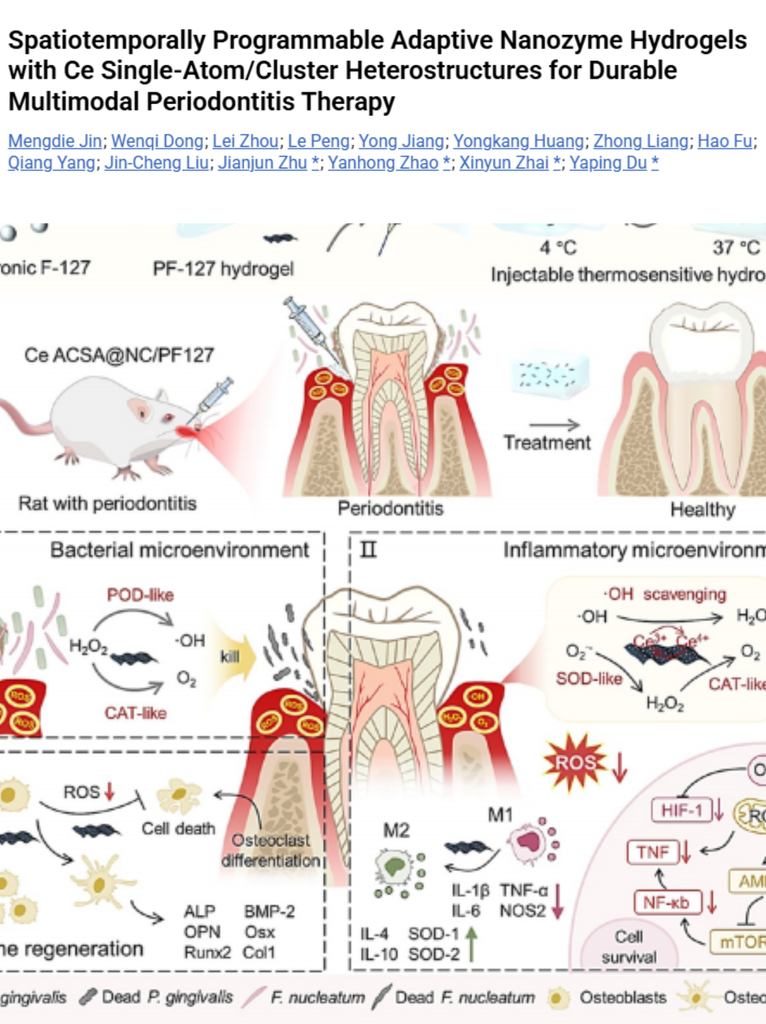
Background: Chronic oral inflammation is often accompanied by microbial dysbiosis, oxidative stress, and bone resorption, and the microenvironment changes over stages, making it difficult for a single approach to address all aspects. At the lesion site, mild acidity, elevated ROS, hypoxia, and immune dysregulation overlap, making precise intervention difficult. Focusing on these dynamic features, the research aims to develop nanozyme systems that can switch their catalytic behavior according to the microenvironment, striving to achieve spatiotemporal matching in different regions such as bacterial, inflammatory, and bone-repair sites.
Research Innovation: Cerium single atoms and atomic clusters are anchored on nitrogen-doped carbon to form a nine-coordinate structure, which exhibits stronger multi-enzyme-mimicking capability than four-coordinate single atoms. It can preferentially produce ·OH through POD-like activity in a weakly acidic bacterial environment and preferentially scavenge ROS through CAT-like/SOD-like activity in a neutral inflammatory environment, enabling pH responsiveness and stage adaptation. Combined with a thermosensitive hydrogel, it undergoes in situ gelation after injection, prolongs retention, and provides sustained release, targeting the bacterial, inflammatory, and bone-repair microenvironments.
Materials Research: The core material is Ce ACSA@NC, in which single atoms and sub-nanometer cerium-oxygen clusters coexist. EXAFS shows that Ce-N/O is approximately nine-coordinate, with Ce predominantly in the +3 oxidation state. It can scavenge H2O2, O2−, and ·OH, and can also produce ·OH and O2 in a bacterial environment, disrupting biofilms. At the cellular level, it can reduce ROS, alleviate hypoxia, promote M2 polarization, and upregulate osteogenesis-related genes. PF127 hydrogel rapidly gels at 37°C, provides sustained release, and adheres to the tooth surface, serving as a carrier for oral microenvironment regulation.
Original Title: Spatiotemporally Programmable Adaptive Nanozyme Hydrogels with Ce Single-Atom/Cluster Heterostructures for Durable Multimodal Periodontitis Therapy
Note: This article is intended only to share frontier developments and does not constitute any related advice.
#Nanozymes #SingleAtomCatalysis #RareEarthMaterials #ThermosensitiveHydrogel #ROSRegulation #OralMicroenvironment #LiteratureSharing #ResearchFrontiers
DOI: 10.1021/acsnano.6c09745